


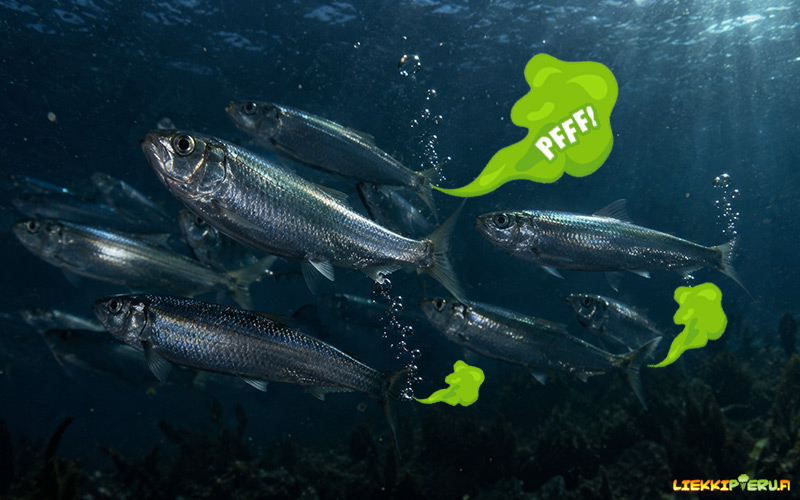
Do Fish Fart and Do Herring Communicate with Bubbles?
Fish can release gas near their rear end, but not every bubble should be described as a digestive fart. The gas may originate in the intestine, come from swallowed air or be released from the swim bladder, an organ that helps many fish control their buoyancy. Herring are especially interesting because they have been observed releasing bubbles near the anal area while producing rapid clicking sounds. Researchers have suggested that this behaviour might serve a social function, but there is no conclusive evidence of an actual fart-based language. Underwater conversation is possible, but its dictionary has yet to be written.
When can a bubble be called a fart?
In humans, a fart is gas that leaves the digestive tract through the rectum. Some gas enters the gut when air is swallowed, while intestinal microbes also produce gas as they process substances that have not been fully absorbed.
Determining the origin of a bubble released by a fish is more difficult. A fish may expel gas from its digestive tract, but the bubble can also come from its swim bladder. In that case, it is not necessarily a by-product of digestion, even if it emerges from a very fart-like location.
In everyday language, a bubble escaping from a fish’s rear end can easily earn the title of fart. Biologically, however, releasing gas may be the more accurate expression. If the origin of the bubble is unknown, it is best not to judge the fish’s diet or manners too quickly.
Gas production also varies greatly between animal species. For a very different look at flatulence in the animal kingdom, read why Cows farts more and how animal digestion can produce surprising amounts of gas.
What is a swim bladder?
The swim bladder is a gas-filled organ found in many bony fish. It helps a fish control its buoyancy and remain at a chosen depth without constantly swimming upwards or downwards. The structure of the organ and the way its gas content is regulated vary between groups of fish.
In some fish, the swim bladder is connected to the digestive tract. These fish can take gas into the bladder or release it through this connection. Other species have no such connection and regulate the amount of gas through the bloodstream.
A swim bladder can also help produce or amplify sound. A fish may use specialised muscles to make the bladder vibrate or employ it as part of another sound-producing mechanism. Fish sounds are therefore not always connected to rear-end bubbles, even if the underwater soundscape occasionally resembles a suspicious bubbling disco.
What did researchers observe in herring?
A study published in 2004 examined Pacific herring and Atlantic herring. The researchers recorded sounds made by wild-caught fish held in captivity while simultaneously filming their behaviour.
The herring produced bursts of rapidly repeated pulses. Researchers called these sounds Fast Repetitive Ticks, or FRTs. In Atlantic herring, video recordings connected the sounds with bubbles being released near the anal area. The gas may have originated in either the intestine or the swim bladder, so the research did not establish that the sound came from an ordinary digestive fart.
Pacific herring also produced the sounds when they did not have direct access to the water’s surface. This finding argued against the sounds depending entirely on air swallowed immediately before the experiment. Feeding did not explain when the sounds occurred either.
The sounds were recorded particularly at night. The number produced by each fish increased when more herring were present, leading the researchers to consider whether the behaviour might have a social function. The study did not determine precisely what that function might be.
Do herring really communicate by farting?
The idea of herring using farts to communicate is irresistible, but it goes further than the original research can confirm. The researchers observed a connection between bubbles and sounds, as well as an increase in sound production when fish were kept in larger groups. These findings are compatible with a possible social function, but they do not reveal the content of any message.
The sounds might help members of a shoal detect one another in darkness. They could assist the group in staying together or relate to another behaviour that the experiment was not designed to identify. Scientists do not know whether a herring is signalling danger, announcing its position or simply producing a sound that tells others another fish is nearby.
The word communication does not necessarily imply a deliberate conversation. An animal may produce a sound to which others respond without consciously constructing a message. There is no proven herring bubble language in which one tick means food and two summon the entire shoal.
How to evaluate a claim about a farting fish
When you encounter a video or story claiming that a fish is farting, check at least the following details:
- Where does the bubble appear to originate? Gas released from the mouth or gills is not a fart.
- Is the origin of the gas known? Digestive gas and gas released from a swim bladder are not necessarily the same phenomenon.
- Which species is involved? Behaviour observed in one species cannot automatically be attributed to every fish.
- Was sound recorded at the same time? The notable herring observation involved the association between bubbles and rapid sounds.
- Is the claim based on research or only a video caption? An amusing clip cannot reveal why a bubble formed.
- Is communication presented as certain? A social function for herring bubble sounds remains a possible interpretation rather than a settled fact.
Looking for connections between observations is a form of puzzle-solving, and a number sequence game offers a completely different way to strengthen your mathematical thinking by identifying recurring patterns.
In most everyday situations, a single bubble seen in an aquarium does not indicate anything exceptional. If a pet fish’s swimming position, appetite, appearance or general behaviour changes, its condition should not be diagnosed from a humorous fish-fart video. Advice can instead be sought from a veterinarian familiar with fish or another qualified aquarium specialist.
Not all fish produce bubbles in the same way
Fish are an extremely diverse group of animals. Their digestive systems, swim bladders and methods of obtaining oxygen vary considerably. Some species do not have a swim bladder at all.
Certain fish can absorb oxygen from swallowed air through the intestine or another specialised organ. Air used in this form of respiration may later leave through the digestive tract. Such gas release can look very much like farting, although its biological purpose is connected to breathing rather than intestinal fermentation.
This behaviour does not mean that a fish is using gas to communicate. The herring observation is particularly interesting because the bubbles were associated with a recognisable series of sounds and the rate of sound production changed with group size.
There is therefore no single answer that applies to every fish. Some species can expel gas through the digestive tract, while herring release bubbles in a manner that generates sound. However, not all fish bubbles originate in digestion, and not every underwater pop is a biological greeting from the rear.
Fish can make sounds in many other ways
The underwater world is far from silent. Fish can create sound by moving parts of their skeleton, rubbing structures together, using muscles associated with the swim bladder or rapidly changing direction in the water. The exact mechanism depends on the species.
These sounds can be connected with courtship, territorial behaviour, alarm responses or keeping a group together. The fact that one fish produces sound through a particular mechanism does not show that another species uses sound for the same reason.
This is why colourful descriptions such as talking, singing or farting need to be interpreted carefully in animal stories. They can make an unfamiliar phenomenon easy to imagine, but they should not replace the biological explanation.
Could an aquarium fish fart?
An aquarium fish may release gas, but an observer cannot usually determine the gas’s origin merely by watching a bubble. It might be swallowed air, gas connected with the swim bladder or gas passing through the digestive system.
One isolated bubble is generally less informative than the fish’s overall condition. Persistent changes in buoyancy, unusual swimming, loss of appetite, swelling or difficulty remaining upright deserve more attention than the comic appearance of the bubble itself.
Aquarium owners should also avoid trying to make a fish produce gas or experimenting with unsuitable foods. Feeding should be based on the needs of the species, not on an attempt to recreate an entertaining online clip.
The sea contains more than the sound of waves
Fish can release gas and produce sounds in several ways, meaning the underwater world includes far more clicks, pulses and bubbles than a person standing on the shore might realise. Herring release bubbles near their anal area while producing rapid ticking sounds, and researchers continue to consider whether the behaviour has a social role.
The cautious answer is therefore yes: at least some fish release gas in a way that closely resembles farting. In herring, the bubbling may be connected with keeping in contact with the shoal, but scientists have not established a genuine fart language. Until further evidence emerges, the fish can keep their bubbling secrets.


